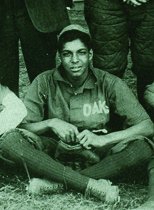
Ollie Johnson’s story begins in the 1850s, when his family escaped slavery by travelling from the US to Canada via the Underground Railroad. Forty-some years later, Johnson was born in Oakville, where he would become one of the town’s greatest athletes for several decades.
Throughout his school years, Johnson was a track and baseball star. He played for the senior baseball Oakville Oaks as a talented shortstop, and then joined the Cuban Giants—a Buffalo-based black pro baseball club that toured North America.
During the World War One, Johnson was drafted into the army, going overseas with the 8th Canadian reserve battalion. While abroad, he competed in the Armed Forces track competitions, where he set a record of 10 seconds in the 100-yard sprint, and 24 seconds in the 220-yard dash.
For these feats, he became the Armed Forces Champion Sprinter.
Following the war, Johnson represented Canada at the British Empire Games in London, England as well as the Inter-Allied Games in Paris. There, Ollie anchored the Canadian 880-yard relay team, which won first place in world record time. Despite his successes, he was denied the opportunity to participate in the 1920 Olympics due to his “amateur status.”
With this, he returned to Oakville, where he achieved a variety of track victories, including the first gold medal of the Coliseum Games at the Canadian National Exhibition in Toronto.
While competing in track, Johnson never forgot about baseball; he played with many championship teams in the 1920s, including Hamilton’s City League International Harvesters After retiring as a competitor, Ollie coached other Oakville athletes of Olympic calibre, including Pete Sutton and Pete ‘Cyclone’ Taylor. He also maintained his interest in baseball by managing a number of championship teams. After his passing in 1977, the Halton County senior baseball league created the Ollie Johnson Division in his memory.