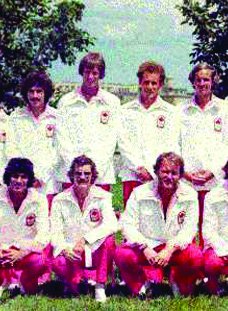
James C. MacDougall’s fanaticism for field hockey began in a wholly unexpected place—on the ice rinks of Glasgow, Scotland. There, he met his first love, ice hockey, which he excelled at; as a teenager, he played for the Paisley Ice Hockey Team, Scotland’s junior-level squad. At this time, however, he also honed his skills on the field, playing for Scotland’s National Under 23 field hockey team.
In 1967, MacDougall’s athletic career nearly came to a premature end: he immigrated to Oakville to accept an engineering position with Ford of Canada. Luckily, the Toronto Field Hockey Club contacted him, drafted him, and made him a member of their group—all within days of his move. During this time, he continued to play ice hockey as a goalie, and even spent time with a US farm team. However, after a number of knee injuries, he hung up his blades and slipped into his cleats full-time. At this point, MacDougall’s field hockey career exploded. He became a member of Toronto’s Ookpics Field Hockey Club, where he served as a player, coach and President of the club. Due to his incredible performance, he became captain of Canada’s National Field Hockey Team, and attended the 1976 Summer Olympics in Montreal.
In 1977, MacDougall became the coach of the Canadian National Team, a position he held until 1980. At this time, he turned his attention to the provincial level, coaching both of Ontario’s Provincial Men’s Teams to their first national gold medals in 1981. MacDougall’s coaching experience brought with it a key realization: with a short outdoor season, Canadian teams simply couldn’t measure up to their international competitors.
As such, he set his sights on improving Canada’s indoor field hockey offerings, and began an intense campaign: he researched, lobbied and wrote position papers championing the future of this exciting version of field hockey. From 1986 to 1991, he coached the Canadian National Indoor Team, taking Canada to an enviable 4th place finish at the 1991 World Cup—in just 10 short years. At this time, MacDougall was also involved with the Oakville Field Hockey Club.
As its head coach and umpire-in-chief, he attracted 350 members to the organization, making it the largest field hockey club in Ontario—a title it still holds today. With his expertise, guidance, and sharp Scottish sense of humour, he has inspired generations of players and placed Oakville on the map.