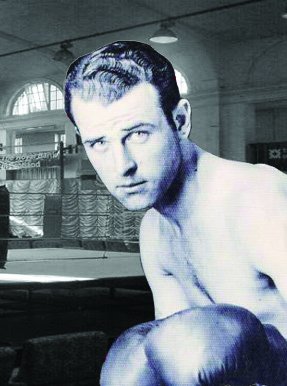
Too light for football and too short pick for Jack Duggan. And, for a poor Irish kid growing up during the Great Depression, it was better than hanging around with nothing to do. With this in mind, a 15-year-old Duggan joined the Monarch Athletic Club in 1935, where he began his illustrious athletic career.
Following his high school graduation, Duggan enlisted with the Canadian Army. In 1939, he found himself in England with the Canadian First Division, where he acted as a physical instructor. At this time, he began sparring with Dave McCleave, a former British welterweight champion, and decided to compete in the Canadian Army Overseas Welterweight Championship—an event he won in both 1945 and 1946. him the distinction of providing the longest continuous service overseas with the Canadian Army.
However, his boxing career was just beginning: until 1951, he tore up the canvas at a fast and furious pace. When he finally decided to hang up his gloves, he’d set an impressive record of 29 wins, two draws, and two losses, leaving his mark on the face of this sport. Duggan then returned to the Canadian Army, and was finally discharged as Captain in 1964.
After his retirement, Duggan remained involved in boxing as a manager and trainer of professional athletes—including the Canadian Junior Olympic team. Additionally, he spent 11 years as a physical instructor with the Region of Peel’s Cadet Organization Police School the Deaf in Milton; and 10 years with the Shamrock Boy’s Town Athletic Club. Additionally, Duggan served as president of the Ontario Boxing Association and the Canadian Boxing Hall of Fame, into which he was inducted in 1973.
Duggan also contributed regularly as a writer to The Boxing Newsletter and The Ring, and penned two books, Fighting for Glory and Hamilton’s Other Tigers. He lived in Oakville for 45 years, where he raised his five children. He was also heavily involved in the community, acting as a congregant of Hopedale Bible Chapel and a Life Member of the Royal Canadian Legion.